

How Was The First Camera Made
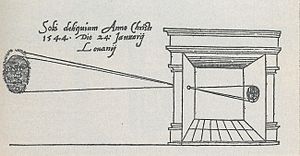
First published movie of a camera obscura in Gemma Frisius' 1545 book De Radio Astronomica et Geometrica
The history of the photographic camera began fifty-fifty before the introduction of photography. Cameras evolved from the camera obscura through many generations of photographic technology – daguerreotypes, calotypes, dry plates, picture – to the modernistic day with digital cameras and camera phones.
Camera obscura (11th–17th centuries) [edit]
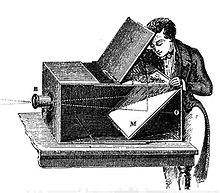
An artist using an 18th-century camera obscura to trace an image
The precursor to the photographic camera was the camera obscura. Photographic camera obscura (Latin for "dark room") is the natural optical miracle that occurs when an image of a scene at the other side of a screen (or for case a wall) is projected through a small pigsty in that screen and forms an inverted paradigm (left to correct and upside downward) on a surface reverse to the opening. The oldest known record of this principle is a description by Han Chinese philosopher Mozi (c. 470 to c. 391 BC). Mozi correctly asserted that the camera obscura image is inverted because lite travels in straight lines from its source. In the 11th century, Arab physicist Ibn al-Haytham (Alhazen) wrote very influential books nigh optics, including experiments with light through a pocket-sized opening in a darkened room.
The apply of a lens in the opening of a wall or closed window shutter of a darkened room to project images used as a drawing aid has been traced back to circa 1550. Since the late 17th-century portable camera obscura devices in tents and boxes were used every bit a drawing aid.
Before the invention of photographic processes, at that place was no way to preserve the images produced past these cameras apart from manually tracing them. The primeval cameras were room-sized, with space for i or more than people inside; these gradually evolved into more and more compact models. By Niépce'due south time, portable box camera obscurae suitable for photography were readily bachelor. The first camera that was minor and portable plenty to be practical for photography was envisioned past Johann Zahn in 1685, though it would be almost 150 years before such an application was possible.
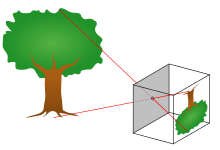
Pinhole camera. Low-cal enters a dark box through a modest hole and creates an inverted image on the wall opposite the hole.[one]
Ibn al-Haytham (c. 965–1040 AD), an Arab physicist likewise known as Alhazen, wrote very influential essays almost the photographic camera obscura, including experiments with light through a pocket-size opening in a darkened room.[2] The invention of the camera has been traced back to the work of Ibn al-Haytham,[3] who is credited with the invention of the pinhole camera.[4] While the effects of a single light passing through a pinhole had been described before,[iii] Ibn al-Haytham gave the starting time correct analysis of the photographic camera obscura,[5] including the get-go geometrical and quantitative descriptions of the phenomenon,[6] and was the first to use a screen in a night room so that an prototype from i side of a hole in the surface could be projected onto a screen on the other side.[7] He too starting time understood the human relationship between the focal point and the pinhole,[8] and performed early experiments with afterimage.
Ibn al-Haytam's writings on eyes became very influential in Europe through Latin translations, inspiring people such every bit Witelo, John Peckham, Roger Salary, Leonardo da Vinci, René Descartes and Johannes Kepler.[two] Camera Obscura were used equally cartoon aids since at least circa 1550. Since the late 17th century, portable photographic camera obscura devices in tents and boxes were used as drawing aids.[ commendation needed ]
Early photographic camera (18th–19th centuries) [edit]
Earlier the evolution of the photographic photographic camera, it had been known for hundreds of years that some substances, such as silver salts, darkened when exposed to sunlight.[9] : 4 In a series of experiments, published in 1727, the German language scientist Johann Heinrich Schulze demonstrated that the concealment of the salts was due to light lonely, and non influenced past oestrus or exposure to air.[x] : vii The Swedish chemist Carl Wilhelm Scheele showed in 1777 that argent chloride was especially susceptible to darkening from light exposure, and that once darkened, information technology becomes insoluble in an ammonia solution.[ten] The first person to utilize this chemistry to create images was Thomas Wedgwood.[9] To create images, Wedgwood placed items, such as leaves and insect wings, on ceramic pots coated with silver nitrate, and exposed the gear up-up to light. These images weren't permanent, notwithstanding, as Wedgwood didn't utilize a fixing machinery. He ultimately failed at his goal of using the process to create fixed images created past a photographic camera obscura.[10] : 8
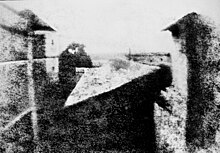
The first permanent photograph of a camera epitome was made in 1825 past Joseph Nicéphore Niépce using a sliding wooden box camera made by Charles and Vincent Chevalier in Paris.[x] : ix–eleven Niépce had been experimenting with ways to set the images of a camera obscura since 1816. The photograph Niépce succeeded in creating shows the view from his window. It was made using an eight-hour exposure on pewter coated with bitumen.[10] : nine Niépce called his procedure "heliography".[9] : 5 Niépce corresponded with the inventor Louis-Jacques-Mandé Daguerre, and the pair entered into a partnership to ameliorate the heliographic process. Niépce had experimented further with other chemicals, to improve contrast in his heliographs. Daguerre contributed an improved camera obscura design, simply the partnership ended when Niépce died in 1833.[10] : 10 Daguerre succeeded in developing a high-contrast and extremely sharp image by exposing on a plate coated with silverish iodide, and exposing this plate again to mercury vapor.[9] : six By 1837, he was able to fix the images with a common salt solution. He chosen this process Daguerreotype, and tried unsuccessfully for a couple of years to commercialize information technology. Somewhen, with help of the scientist and politician François Arago, the French authorities acquired Daguerre's process for public release. In exchange, pensions were provided to Daguerre besides as Niépce'due south son, Isidore.[10] : 11
In the 1830s, the English scientist William Henry Fox Talbot independently invented a process to capture photographic camera images using silver salts.[11] : 15 Although dismayed that Daguerre had beaten him to the announcement of photography, he submitted on Jan 31, 1839, a pamphlet to the Royal Institution entitled Some Business relationship of the Art of Photogenic Drawing, which was the kickoff published description of photography. Within two years, Talbot developed a two-step process for creating photographs on paper, which he called calotypes. The calotype procedure was the first to employ negative printing, which reverses all values in the reproduction process – black shows up as white and vice versa.[9] : 21 Negative press allows, in principle, an unlimited number of positive prints to be made from the original negative.[11] : 16 The Calotype process also introduced the ability for a printmaker to alter the resulting image through retouching of the negative.[11] : 67 Calotypes were never as popular or widespread as daguerreotypes,[9] : 22 attributable mainly to the fact that the latter produced sharper details.[12] : 370 However, because daguerreotypes only produce a direct positive print, no duplicates can be fabricated. Information technology is the two-pace negative/positive process that formed the ground for modernistic photography.[10] : xv

The Giroux daguerreotype camera fabricated by Maison Susse Frères in 1839, with a lens past Charles Chevalier, the offset to be commercially produced[9] : 9
The first photographic camera developed for commercial manufacture was a daguerreotype camera, built past Alphonse Giroux in 1839. Giroux signed a contract with Daguerre and Isidore Niépce to produce the cameras in French republic,[ix] : eight–nine with each device and accessories costing 400 francs.[13] : 38 The camera was a double-box blueprint, with a landscape lens fitted to the outer box, and a holder for a ground glass focusing screen and image plate on the inner box. By sliding the inner box, objects at various distances could be brought to as sharp a focus as desired. After a satisfactory prototype had been focused on the screen, the screen was replaced with a sensitized plate. A knurled wheel controlled a copper flap in front of the lens, which functioned as a shutter. The early on daguerreotype cameras required long exposure times, which in 1839 could be from v to thirty minutes.[9] [xiii] : 39
Afterwards the introduction of the Giroux daguerreotype camera, other manufacturers quickly produced improved variations. Charles Chevalier, who had before provided Niépce with lenses, created in 1841 a double-box camera using a half-sized plate for imaging. Chevalier'south camera had a hinged bed, assuasive for half of the bed to fold onto the back of the nested box. In addition to having increased portability, the camera had a faster lens, bringing exposure times downwards to 3 minutes, and a prism at the front end of the lens, which allowed the paradigm to be laterally correct.[fourteen] : 6 Some other French blueprint emerged in 1841, created by Marc Antoine Gaudin. The Nouvel Appareil Gaudin camera had a metallic disc with 3 differently-sized holes mounted on the front of the lens. Rotating to a different hole finer provided variable f-stops, allowing unlike amounts of light into the photographic camera.[fifteen] : 28 Instead of using nested boxes to focus, the Gaudin camera used nested brass tubes.[xiv] : seven In Germany, Peter Friedrich Voigtländer designed an all-metallic camera with a conical shape that produced circular pictures of about 3 inches in diameter. The distinguishing feature of the Voigtländer photographic camera was its utilize of a lens designed past Joseph Petzval.[eleven] : 34 The f/3.v Petzval lens was nearly 30 times faster than any other lens of the period, and was the first to be made specifically for portraiture. Its design was the virtually widely used for portraits until Carl Zeiss introduced the anastigmat lens in 1889.[10] : 19
Within a decade of being introduced in America, three full general forms of camera were in popular use: the American- or chamfered-box photographic camera, the Robert'southward-blazon camera or "Boston box", and the Lewis-type camera. The American-box camera had beveled edges at the front and rear, and an opening in the rear where the formed image could be viewed on ground glass. The acme of the camera had hinged doors for placing photographic plates. Inside at that place was i available slot for distant objects, and another slot in the back for close-ups. The lens was focused either by sliding or with a rack and pinion mechanism. The Robert's-blazon cameras were like to the American-box, except for having a knob-fronted worm gear on the forepart of the photographic camera, which moved the back box for focusing. Many Robert's-type cameras allowed focusing directly on the lens mount. The third popular daguerreotype photographic camera in America was the Lewis-type, introduced in 1851, which utilized a bellows for focusing. The main body of the Lewis-blazon camera was mounted on the front box, but the rear section was slotted into the bed for easy sliding. Once focused, a set screw was tightened to hold the rear department in place.[15] : 26–27 Having the bellows in the eye of the trunk facilitated making a 2nd, in-camera copy of the original paradigm.[14] : 17
Daguerreotype cameras formed images on silvered copper plates and images were only able to develop with mercury vapor.[16] The earliest daguerreotype cameras required several minutes to half an hour to expose images on the plates. Past 1840, exposure times were reduced to just a few seconds owing to improvements in the chemical training and development processes, and to advances in lens pattern.[17] : 38 American daguerreotypists introduced manufactured plates in mass product, and plate sizes became internationally standardized: whole plate (half dozen.5 x viii.5 inches), three-quarter plate (5.5 x 7 1/eight inches), one-half plate (four.5 x 5.5 inches), quarter plate (3.25 x 4.25 inches), sixth plate (ii.75 x 3.25 inches), and ninth plate (2 10 two.5 inches).[11] : 33–34 Plates were often cut to fit cases and jewelry with circular and oval shapes. Larger plates were produced, with sizes such equally 9 10 xiii inches ("double-whole" plate), or 13.5 10 16.5 inches (Southworth & Hawes' plate).[15] : 25
The collodion moisture plate procedure that gradually replaced the daguerreotype during the 1850s required photographers to glaze and sensitize thin glass or atomic number 26 plates shortly before use and betrayal them in the camera while withal moisture. Early wet plate cameras were very elementary and little different from Daguerreotype cameras, but more sophisticated designs eventually appeared. The Dubroni of 1864 allowed the sensitizing and developing of the plates to be carried out inside the camera itself rather than in a separate darkroom. Other cameras were fitted with multiple lenses for photographing several small portraits on a unmarried larger plate, useful when making cartes de visite. It was during the wet plate era that the utilise of bellows for focusing became widespread, making the bulkier and less easily adapted nested box blueprint obsolete.
For many years, exposure times were long plenty that the photographer just removed the lens cap, counted off the number of seconds (or minutes) estimated to be required by the lighting conditions, then replaced the cap. As more than sensitive photographic materials became available, cameras began to incorporate mechanical shutter mechanisms that immune very brusk and accurately timed exposures to be made.
The utilize of photographic movie was pioneered by George Eastman, who started manufacturing paper film in 1885 before switching to celluloid in 1889. His first camera, which he called the "Kodak," was first offered for sale in 1888. It was a very uncomplicated box photographic camera with a stock-still-focus lens and unmarried shutter speed, which along with its relatively low price appealed to the boilerplate consumer. The Kodak came pre-loaded with enough film for 100 exposures and needed to be sent dorsum to the factory for processing and reloading when the gyre was finished. Past the end of the 19th century Eastman had expanded his lineup to several models including both box and folding cameras.
Films also made possible capture of motion (cinematography) establishing the picture manufacture by the end of the 19th century.
Early on fixed images [edit]
The first partially successful photo of a photographic camera image was fabricated in approximately 1816 by Nicéphore Niépce,[18] [19] using a very modest photographic camera of his ain making and a slice of paper coated with silver chloride, which darkened where it was exposed to calorie-free. No means of removing the remaining unaffected silver chloride was known to Niépce, and so the photo was not permanent, somewhen becoming entirely darkened by the overall exposure to calorie-free necessary for viewing it. In the mid-1820s, Niépce used a sliding wooden box camera fabricated past Parisian opticians Charles and Vincent Chevalier, to experiment with photography on surfaces thinly coated with Bitumen of Judea.[20] The bitumen slowly hardened in the brightest areas of the epitome. The unhardened bitumen was then dissolved abroad. Ane of those photographs has survived.
Daguerreotypes and calotypes [edit]
After Niépce'south death in 1830, his partner Louis Daguerre continued to experiment and by 1837 had created the first applied photographic procedure, which he named the daguerreotype and publicly unveiled in 1839.[21] Daguerre treated a silver-plated sail of copper with iodine vapor to give it a blanket of calorie-free-sensitive silver iodide. After exposure in the camera, the image was developed by mercury vapor and fixed with a stiff solution of ordinary salt (sodium chloride). Henry Fox Talbot perfected a different process, the calotype, in 1840. Every bit commercialized, both processes used very simple cameras consisting of two nested boxes. The rear box had a removable ground glass screen and could slide in and out to adjust the focus. Afterward focusing, the ground glass was replaced with a calorie-free-tight holder containing the sensitized plate or paper and the lens was capped. Then the photographer opened the front cover of the holder, uncapped the lens, and counted off as many minutes equally the lighting conditions seemed to crave before replacing the cap and endmost the holder. Despite this mechanical simplicity, high-quality achromatic lenses were standard.[22]

Late 19th-century studio camera
Dry plates [edit]
Collodion dry plates had been available since 1857, thanks to the piece of work of Désiré van Monckhoven, but it was not until the invention of the gelatin dry plate in 1871 by Richard Leach Maddox that the wet plate process could be rivaled in quality and speed. The 1878 discovery that heat-ripening a gelatin emulsion greatly increased its sensitivity finally fabricated so-called "instantaneous" snapshot exposures practical. For the first time, a tripod or other support was no longer an accented necessity. With daylight and a fast plate or motion-picture show, a small-scale camera could be hand-held while taking the movie. The ranks of apprentice photographers swelled and informal "candid" portraits became popular. There was a proliferation of camera designs, from single- and twin-lens reflexes to big and bulky field cameras, simple box cameras, and even "detective cameras" bearded equally pocket watches, hats, or other objects.
The short exposure times that made candid photography possible also necessitated some other innovation, the mechanical shutter. The very first shutters were dissever accessories, though built-in shutters were common by the finish of the 19th century.[22]
Invention of photographic motion-picture show [edit]
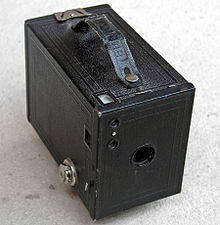
Kodak No. ii Credibility box photographic camera, circa 1920
The use of photographic picture was pioneered by George Eastman, who started manufacturing paper film in 1885 before switching to celluloid in 1888–1889. His kickoff photographic camera, which he called the "Kodak", was start offered for sale in 1888. It was a very simple box camera with a stock-still-focus lens and unmarried shutter speed, which along with its relatively low price appealed to the average consumer. The Kodak came pre-loaded with enough film for 100 exposures and needed to be sent back to the factory for processing and reloading when the roll was finished. By the end of the 19th century Eastman had expanded his lineup to several models including both box and folding cameras.
In 1900, Eastman took mass-market photography ane step further with the Brownie, a elementary and very inexpensive box camera that introduced the concept of the snapshot. The Brownie was extremely popular and various models remained on sale until the 1960s.
Picture show also allowed the motion picture camera to develop from an expensive toy to a applied commercial tool.
Despite the advances in depression-cost photography made possible by Eastman, plate cameras still offered college-quality prints and remained popular well into the 20th century. To compete with rollfilm cameras, which offered a larger number of exposures per loading, many cheap plate cameras from this era were equipped with magazines to hold several plates at once. Special backs for plate cameras assuasive them to use motion-picture show packs or rollfilm were also bachelor, as were backs that enabled rollfilm cameras to use plates.
Except for a few special types such equally Schmidt cameras, nigh professional astrographs continued to employ plates until the end of the 20th century when electronic photography replaced them.
35 mm [edit]
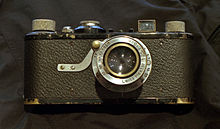

A number of manufacturers started to use 35 mm film for nonetheless photography between 1905 and 1913. The first 35 mm cameras available to the public, and reaching significant numbers in sales were the Tourist Multiple, in 1913, and the Simplex, in 1914.[ citation needed ]
Oskar Barnack, who was in charge of research and evolution at Leitz, decided to investigate using 35 mm cine movie for still cameras while attempting to build a compact photographic camera capable of making loftier-quality enlargements. He built his prototype 35 mm camera (Ur-Leica) around 1913, though farther development was delayed for several years past World War I. It wasn't until afterwards World War I that Leica commercialized their kickoff 35 mm cameras. Leitz exam-marketed the design between 1923 and 1924, receiving enough positive feedback that the photographic camera was put into production equally the Leica I (for Leitz camera) in 1925. The Leica's immediate popularity spawned a number of competitors, nigh notably the Contax (introduced in 1932), and cemented the position of 35 mm as the format of choice for high-end compact cameras.
Kodak got into the market with the Retina I in 1934, which introduced the 135 cartridge used in all modern 35 mm cameras. Although the Retina was comparatively inexpensive, 35 mm cameras were still out of reach for nigh people and rollfilm remained the format of option for mass-market cameras. This changed in 1936 with the introduction of the inexpensive Argus A and to an even greater extent in 1939 with the arrival of the immensely popular Argus C3. Although the cheapest cameras notwithstanding used rollfilm, 35 mm picture show had come to dominate the market place by the time the C3 was discontinued in 1966.
The fledgling Japanese camera industry began to accept off in 1936 with the Catechism 35 mm rangefinder, an improved version of the 1933 Kwanon epitome. Japanese cameras would begin to become popular in the West afterward Korean War veterans and soldiers stationed in Nihon brought them back to the United States and elsewhere.
TLRs and SLRs [edit]

The start practical reflex camera was the Franke & Heidecke Rolleiflex medium format TLR of 1928. Though both single- and twin-lens reflex cameras had been available for decades, they were also bulky to reach much popularity. The Rolleiflex, however, was sufficiently meaty to attain widespread popularity and the medium-format TLR design became pop for both high- and depression-end cameras.
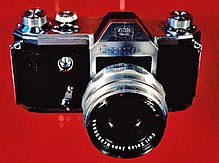
A similar revolution in SLR blueprint began in 1933 with the introduction of the Ihagee Exakta, a meaty SLR which used 127 rollfilm. This was followed three years later by the first Western SLR to use 135 film, the Kine Exakta (World'due south showtime truthful 35mm SLR was Soviet "Sport" camera, marketed several months earlier Kine Exakta, though "Sport" used its own film cartridge). The 35mm SLR design gained immediate popularity and in that location was an explosion of new models and innovative features after World State of war Two. There were also a few 35 mm TLRs, the best-known of which was the Contaflex of 1935, just for the most part these met with little success.
The outset major post-war SLR innovation was the eye-level viewfinder, which first appeared on the Hungarian Duflex in 1947 and was refined in 1948 with the Contax S, the first camera to use a pentaprism. Prior to this, all SLRs were equipped with waist-level focusing screens. The Duflex was besides the first SLR with an instant-return mirror, which prevented the viewfinder from being blacked out after each exposure. This same fourth dimension menses also saw the introduction of the Hasselblad 1600F, which set the standard for medium format SLRs for decades.
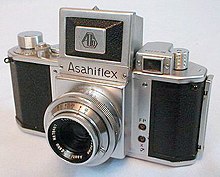
In 1952 the Asahi Optical Company (which later became well known for its Pentax cameras) introduced the kickoff Japanese SLR using 135 film, the Asahiflex. Several other Japanese photographic camera makers also entered the SLR market in the 1950s, including Canon, Yashica, and Nikon. Nikon'southward entry, the Nikon F, had a full line of interchangeable components and accessories and is more often than not regarded as the first Japanese system camera. Information technology was the F, along with the earlier Due south series of rangefinder cameras, that helped establish Nikon's reputation as a maker of professional person-quality equipment and one of the earth's best known brands.
Instant cameras [edit]

While conventional cameras were becoming more refined and sophisticated, an entirely new blazon of photographic camera appeared on the marketplace in 1948. This was the Polaroid Model 95, the world's kickoff feasible instant-picture camera. Known as a Land Camera after its inventor, Edwin State, the Model 95 used a patented chemical process to produce finished positive prints from the exposed negatives in under a minute. The Country Camera defenseless on despite its relatively high price and the Polaroid lineup had expanded to dozens of models past the 1960s. The kickoff Polaroid camera aimed at the popular market, the Model 20 Swinger of 1965, was a huge success and remains i of the pinnacle-selling cameras of all time.
Automation [edit]
The first camera to feature automatic exposure was the selenium light meter-equipped, fully automatic Super Kodak Six-20 pack of 1938, but its extremely high price (for the time) of $225 (equivalent to $four,137 in 2020)[23] kept it from achieving whatsoever degree of success. By the 1960s, however, low-cost electronic components were commonplace and cameras equipped with light meters and automated exposure systems became increasingly widespread.
The next technological advance came in 1960, when the German Mec 16 SB subminiature became the first camera to place the lite meter backside the lens for more than accurate metering. However, through-the-lens metering ultimately became a characteristic more commonly found on SLRs than other types of camera; the starting time SLR equipped with a TTL system was the Topcon RE Super of 1962.
Digital cameras [edit]
Digital cameras differ from their analog predecessors primarily in that they do non use picture show, but capture and relieve photographs on digital retention cards or internal storage instead. Their low operating costs have relegated chemical cameras to niche markets. Digital cameras now include wireless communication capabilities (for example Wi-Fi or Bluetooth) to transfer, print, or share photos, and are unremarkably found on mobile phones.
Digital imaging technology [edit]
The start semiconductor image sensor was the CCD, invented by Willard S. Boyle and George East. Smith at Bell Labs in 1969.[24] While researching MOS technology, they realized that an electrical accuse was the analogy of the magnetic chimera and that it could be stored on a tiny MOS capacitor. Equally it was fairly straightforward to fabricate a serial of MOS capacitors in a row, they connected a suitable voltage to them then that the charge could be stepped along from one to the adjacent.[25] The CCD is a semiconductor circuit that was subsequently used in the starting time digital video cameras for television broadcasting.[26]
The NMOS active-pixel sensor (APS) was invented by Olympus in Japan during the mid-1980s. This was enabled by advances in MOS semiconductor device fabrication, with MOSFET scaling reaching smaller micron and and so sub-micron levels.[27] [28] The NMOS APS was fabricated by Tsutomu Nakamura'due south team at Olympus in 1985.[29] The CMOS active-pixel sensor (CMOS sensor) was later on developed by Eric Fossum's team at the NASA Jet Propulsion Laboratory in 1993.[30] [27]
Early on digital camera prototypes [edit]
The concept of digitizing images on scanners, and the concept of digitizing video signals, predate the concept of making still pictures by digitizing signals from an array of discrete sensor elements. Early spy satellites used the extremely circuitous and expensive method of de-orbit and airborne retrieval of picture canisters. Technology was pushed to skip these steps through the utilise of in-satellite developing and electronic scanning of the motion-picture show for direct transmission to the ground. The amount of movie was still a major limitation, and this was overcome and greatly simplified by the push to develop an electronic image capturing array that could be used instead of film. The first electronic imaging satellite was the KH-xi launched by the NRO in belatedly 1976. Information technology had a charge-coupled device (CCD) array with a resolution of 800 10 800 pixels (0.64 megapixels).[31] At Philips Labs in New York, Edward Stupp, Pieter Cath and Zsolt Szilagyi filed for a patent on "All Solid State Radiation Imagers" on 6 September 1968 and constructed a flat-screen target for receiving and storing an optical paradigm on a matrix composed of an assortment of photodiodes connected to a capacitor to form an array of ii concluding devices connected in rows and columns. Their US patent was granted on ten November 1970.[32] Texas Instruments engineer Willis Adcock designed a filmless camera that was not digital and applied for a patent in 1972, just it is not known whether it was ever congenital.[33]
The Cromemco Cyclops, introduced as a hobbyist construction project in 1975,[34] was the first digital camera to be interfaced to a microcomputer. Its image sensor was a modified metal-oxide-semiconductor (MOS) dynamic RAM (DRAM) retentiveness chip.[35]
The first recorded attempt at edifice a self-independent digital camera was in 1975 by Steven Sasson, an engineer at Eastman Kodak.[36] [37] It used the and so-new solid-state CCD image sensor chips developed by Fairchild Semiconductor in 1973.[38] The photographic camera weighed eight pounds (3.6 kg), recorded black-and-white images to a meaty cassette tape, had a resolution of 0.01 megapixels (10,000 pixels), and took 23 seconds to capture its starting time image in Dec 1975. The prototype photographic camera was a technical exercise, non intended for production.
Analog electronic cameras [edit]

Handheld electronic cameras, in the sense of a device meant to be carried and used as a handheld film photographic camera, appeared in 1981 with the demonstration of the Sony Mavica (Magnetic Video Camera). This is not to be confused with the later cameras by Sony that also bore the Mavica name. This was an analog camera, in that it recorded pixel signals continuously, as videotape machines did, without converting them to discrete levels; it recorded boob tube-like signals to a ii × 2 inch "video floppy".[39] In essence, it was a video movie camera that recorded single frames, 50 per disk in field mode, and 25 per disk in frame mode. The image quality was considered equal to that of and then-current televisions.
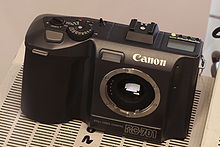
Analog electronic cameras practise non announced to have reached the market until 1986 with the Catechism RC-701. Canon demonstrated a prototype of this model at the 1984 Summer Olympics, press the images in the Yomiuri Shinbun, a Japanese newspaper. In the Us, the start publication to use these cameras for real reportage was U.s. Today, in its coverage of World Series baseball. Several factors held dorsum the widespread adoption of analog cameras; the cost (upwards of $20,000, equivalent to $47,000 in 2020[23]), poor paradigm quality compared to motion picture, and the lack of quality affordable printers. Capturing and printing an image originally required admission to equipment such as a frame grabber, which was beyond the accomplish of the average consumer. The "video floppy" disks after had several reader devices available for viewing on a screen but were never standardized equally a computer drive.
The early adopters tended to be in the news media, where the price was negated by the utility and the ability to transmit images by telephone lines. The poor prototype quality was offset by the low resolution of newspaper graphics. This adequacy to transmit images without a satellite link was useful during the 1989 Tiananmen Square protests and the first Gulf War in 1991.
U.s. government agencies also took a potent involvement in the still video concept, notably the United states of america Navy for use as a existent-time air-to-body of water surveillance system.
The showtime analog electronic camera marketed to consumers may have been the Casio VS-101 in 1987. A notable analog photographic camera produced the same year was the Nikon QV-1000C, designed as a press camera and not offered for sale to general users, which sold only a few hundred units. It recorded images in greyscale, and the quality in newspaper print was equal to film cameras. In appearance information technology closely resembled a modern digital single-lens reflex camera. Images were stored on video floppy disks.
Silicon Motion-picture show, a proposed digital sensor cartridge for film cameras that would permit 35 mm cameras to have digital photographs without modification was announced in late 1998. Silicon Moving-picture show was to work as a gyre of 35 mm film, with a ane.iii megapixel sensor behind the lens and a battery and storage unit of measurement fitting in the motion picture holder in the photographic camera. The production, which was never released, became increasingly obsolete due to improvements in digital photographic camera applied science and affordability. Silicon Films' parent company filed for bankruptcy in 2001.[40]
Early true digital cameras [edit]

Minolta RD-175, the first portable digital SLR camera, introduced by Minolta in 1995.
By the late 1980s, the technology required to produce truly commercial digital cameras existed. The beginning true portable digital camera that recorded images equally a computerized file was likely the Fuji DS-1P of 1988, which recorded to a 2 MB SRAM (static RAM) memory card that used a battery to keep the data in retention. This camera was never marketed to the public.
The starting time digital photographic camera of whatsoever kind ever sold commercially was possibly the MegaVision Tessera in 1987[41] though at that place is not extensive documentation of its sale known. The first portable digital camera that was actually marketed commercially was sold in December 1989 in Japan, the DS-10 by Fuji[42] The outset commercially bachelor portable digital camera in the United States was the Dycam Model one, first shipped in Nov 1990.[43] Information technology was originally a commercial failure considering it was black-and-white, low in resolution, and cost nigh $one,000 (equivalent to $2,000 in 2020[23]).[44] It after saw modest success when information technology was re-sold equally the Logitech Fotoman in 1992. It used a CCD image sensor, stored pictures digitally, and connected straight to a computer for download.[45] [46] [47]
Digital SLRs (DSLRs) [edit]
Nikon was interested in digital photography since the mid-1980s. In 1986, while presenting to Photokina, Nikon introduced an operational prototype of the beginning SLR-type digital camera (Notwithstanding Video Camera), manufactured by Panasonic.[48] The Nikon SVC was built effectually a sensor 2/three " accuse-coupled device of 300,000 pixels. Storage media, a magnetic floppy within the photographic camera allows recording 25 or l B&W images, depending on the definition.[49] In 1988, Nikon released the kickoff commercial DSLR photographic camera, the QV-1000C.[48]
In 1991, Kodak brought to market the Kodak DCS (Kodak Digital Camera System), the kickoff of a long line of professional Kodak DCS SLR cameras that were based in function on film bodies, oft Nikons. It used a 1.iii megapixel sensor, had a bulky external digital storage system and was priced at $xiii,000 (equivalent to $25,000 in 2020[23]). At the inflow of the Kodak DCS-200, the Kodak DCS was dubbed Kodak DCS-100.
The move to digital formats was helped by the formation of the first JPEG and MPEG standards in 1988, which allowed prototype and video files to be compressed for storage. The commencement consumer camera with a liquid crystal display on the dorsum was the Casio QV-x developed by a squad led past Hiroyuki Suetaka in 1995. The get-go camera to utilize CompactFlash was the Kodak DC-25 in 1996.[50] The outset camera that offered the ability to record video clips may have been the Ricoh RDC-i in 1995.
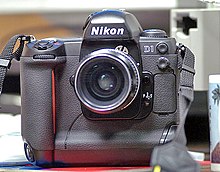
In 1995 Minolta introduced the RD-175, which was based on the Minolta 500si SLR with a splitter and 3 independent CCDs. This combination delivered one.75M pixels. The benefit of using an SLR base was the power to apply any existing Minolta AF mount lens. 1999 saw the introduction of the Nikon D1, a ii.74 megapixel photographic camera that was the first digital SLR adult entirely from the ground up by a major manufacturer, and at a cost of under $6,000 (equivalent to $10,200 in 2020[23]) at introduction was affordable by professional person photographers and high-end consumers. This camera too used Nikon F-mountain lenses, which meant flick photographers could utilize many of the same lenses they already owned.
Digital camera sales continued to flourish, driven by technology advances. The digital market segmented into different categories, Compact Digital Notwithstanding Cameras, Bridge Cameras, Mirrorless Compacts and Digital SLRs.
Since 2003, digital cameras have outsold film cameras[51] and Kodak announced in January 2004 that they would no longer sell Kodak-branded film cameras in the developed earth[52] – and in 2012 filed for bankruptcy afterwards struggling to adapt to the changing manufacture.[53]
Camera phones [edit]
The start commercial camera phone was the Kyocera Visual Phone VP-210, released in Japan in May 1999.[54] It was called a "mobile videophone" at the fourth dimension,[55] and had a 110,000-pixel front-facing camera.[54] It stored up to 20 JPEG digital images, which could be sent over eastward-mail, or the phone could send upwards to two images per second over Japan'due south Personal Handy-telephone Organisation (PHS) cellular network.[54] The Samsung SCH-V200, released in Republic of korea in June 2000, was also one of the commencement phones with a built-in camera. It had a TFT liquid-crystal display (LCD) and stored upward to xx digital photos at 350,000-pixel resolution. However, it could not send the resulting image over the telephone role, but required a estimator connection to admission photos.[56] The first mass-market camera phone was the J-SH04, a Precipitous J-Phone model sold in Nippon in November 2000.[57] [56] It could instantly transmit pictures via cell telephone telecommunications.[58]
Ane of the major engineering science advances was the evolution of CMOS sensors, which helped drive sensor costs depression enough to enable the widespread adoption of camera phones. Smartphones now routinely include high resolution digital cameras.
See also [edit]
- History of photography
- Photographic lens design
- Flick photographic camera
References [edit]
- ^ Kirkpatrick, Larry D.; Francis, Gregory Due east. (2007). "Calorie-free". Physics: A World View (6 ed.). Belmont, California: Thomson Brooks/Cole. p. 339. ISBN978-0-495-01088-3.
- ^ a b Plott, John C. (1984). Global History of Philosophy: The Period of scholasticism (part i). p. 460. ISBN978-0-89581-678-8.
- ^ a b Belbachir, Ahmed Nabil (2010). Smart Cameras. Springer Science & Business Media. ISBN978-i-4419-0953-4.
The invention of the camera can be traced dorsum to the 10th century when the Arab scientist Al-Hasan Ibn al-Haytham allonym Alhacen provided the showtime articulate clarification and correct analysis of the (man) vision process. Although the effects of single low-cal passing through the pinhole accept already been described by the Chinese Mozi (Lat. Micius) (5th century B), the Greek Aristotle (quaternary century BC), and the Arab
- ^ Plott, John C. (1984). Global History of Philosophy: The Period of scholasticism (part 1). p. 460. ISBN978-0-89581-678-8.
Co-ordinate to Nazir Ahmed if only Ibn-Haitham's fellow-workers and students had been every bit warning every bit he, they might even have invented the art of photography since al-Haytham'due south experiments with convex and concave mirrors and his invention of the "pinhole camera" whereby the inverted epitome of a candle-flame is projected were among his many successes in experimentation. I might likewise almost claim that he had anticipated much that the nineteenth century Fechner did in experimentation with after-images.
- ^ Wade, Nicholas J.; Finger, Stanley (2001), "The eye every bit an optical instrument: from camera obscura to Helmholtz's perspective", Perception, 30 (10): 1157–1177, doi:ten.1068/p3210, PMID 11721819, S2CID 8185797,
The principles of the photographic camera obscura starting time began to be correctly analysed in the eleventh century, when they were outlined past Ibn al-Haytham.
- ^ Needham, Joseph. Science and Civilization in Prc, vol. 4, role i: Physics and Physical Engineering science (PDF). p. 98. Archived from the original (PDF) on 3 July 2017. Retrieved 5 September 2016.
Alhazen used the photographic camera obscura particularly for observing solar eclipses, equally indeed Aristotle is said to have done, and information technology seems that, similar Shen Kua, he had predecessors in its study, since he did not merits it as any new finding of his own. Merely his treatment of it was competently geometrical and quantitative for the first fourth dimension.
- ^ "Who Invented Camera Obscura?". Photography History Facts.
All these scientists experimented with a minor hole and calorie-free but none of them suggested that a screen is used then an image from 1 side of a hole on the surface could be projected at the screen on the other. First, one to do and so was Alhazen (also known as Ibn al-Haytham) in 11th century.
- ^ Needham, Joseph. Scientific discipline and Civilisation in Communist china, vol. IV, part ane: Physics and Physical Applied science (PDF). p. 99. Archived from the original (PDF) on 3 July 2017. Retrieved 5 September 2016.
The genius of Shen Kua'due south insight into the relation of focal point and pinhole tin can better be appreciated when we read in Singer that this was first understood in Europe by Leonardo da Vinci (+ 1452 to + 1519), almost five hundred years subsequently. A diagram showing the relation occurs in the Codice Atlantico, Leonardo idea that the lens of the eye reversed the pinhole effect, so that the image did not announced inverted on the retina; though in fact, it does. Actually, the analogy of focal-bespeak and pin-point must take been understood past Ibn al-Haitham, who died just about the fourth dimension when Shen Ku was born.
- ^ a b c d east f grand h i j Gustavson, Todd (2009). Photographic camera: a history of photography from daguerreotype to digital. New York: Sterling Publishing Co., Inc. ISBN978-ane-4027-5656-vi.
- ^ a b c d east f g h i Gernsheim, Helmut (1986). A Concise History of Photography (iii ed.). Mineola, New York: Dover Publications, Inc. ISBN978-0-486-25128-viii.
- ^ a b c d e Hirsch, Robert (2000). Seizing the Light: A History of Photography. New York: McGraw-Hill Companies, Inc. ISBN978-0-697-14361-7.
- ^ London, Barbara; Upton, John; Kobré, Kenneth; Brill, Betsy (2002). Photography (7 ed.). Upper Saddle River, New Jersey: Prentice Hall. ISBN978-0-xiii-028271-ii.
- ^ a b Frizot, Michel (Jan 1998). "Light machines: On the threshold of invention". In Michel Frizot (ed.). A New History of Photography. Koln, Germany: Konemann. ISBN978-3-8290-1328-4.
- ^ a b c Gustavson, Todd (one Nov 2011). 500 Cameras: 170 Years of Photographic Innovation. Toronto, Ontario: Sterling Publishing, Inc. ISBN978-1-4027-8086-8.
- ^ a b c Spira, South.F.; Lothrop, Jr., Easton S.; Spira, Jonathan B. (2001). The History of Photography equally Seen Through the Spira Drove. New York: Aperture. ISBN978-0-89381-953-8.
- ^ "Daguerreotype". Scientific American. 2 (38): 302. 1847. doi:10.1038/scientificamerican06121847-302e. ISSN 0036-8733. JSTOR 24924116.
- ^ Starl, Timm (January 1998). "A New World of Pictures: The Daguerreotype". In Michel Frizot (ed.). A New History of Photography. Koln, Germany: Konemann. ISBN978-3-8290-1328-4.
- ^ Newhall, Beaumont (1982). The History of Photography. New York, New York: The Museum of Modern Art. p. 13. ISBN0-87070-381-1.
Joseph Nicéphore Niépce, of exposure to calorie-free. Although the only example of his photographic camera piece of work that remains today appears to have been made in 1826, his letters go out no doubt that he had succeeded in fixing the camera'south paradigm a decade earlier.
- ^ Leslie Stroebel and Richard D. Zakia (1993). The Focal encyclopedia of photography (3rd ed.). Focal Press. p. six. ISBN978-0-240-51417-8.
- ^ Davenport, Alma (1999). The history of photography: an overview. Albuquerque, NM: University of New Mexico Press. p. half-dozen. ISBN0-8263-2076-7.
- ^ Kosinski Dorothy, The Artist and the Photographic camera, Degas to Picasso. New Oasis: Yale University Press,1999. p.25
- ^ a b Wade, John (1979). A Brusk History of the Camera. Watford: Fountain Printing. ISBN0-85242-640-2.
- ^ a b c d e 1634–1699: McCusker, J. J. (1997). How Much Is That in Real Coin? A Historical Price Index for Use equally a Deflator of Money Values in the Economy of the United States: Addenda et Corrigenda (PDF). American Antiquarian Society. 1700–1799: McCusker, J. J. (1992). How Much Is That in Real Money? A Historical Cost Index for Use as a Deflator of Money Values in the Economy of the United States (PDF). American Antiquarian Society. 1800–present: Federal Reserve Banking company of Minneapolis. "Consumer Price Alphabetize (estimate) 1800–". Retrieved 1 January 2020.
- ^ James R. Janesick (2001). Scientific accuse-coupled devices. SPIE Press. pp. 3–4. ISBN978-0-8194-3698-half-dozen.
- ^ Williams, J. B. (2017). The Electronics Revolution: Inventing the Hereafter. Springer. pp. 245–8. ISBN9783319490885.
- ^ Boyle, William Southward; Smith, George Due east. (1970). "Charge Coupled Semiconductor Devices". Bell Syst. Tech. J. 49 (four): 587–593. doi:10.1002/j.1538-7305.1970.tb01790.x.
- ^ a b Fossum, Eric R. (12 July 1993). Blouke, Morley M. (ed.). "Active pixel sensors: are CCDs dinosaurs?". SPIE Proceedings Vol. 1900: Charge-Coupled Devices and Solid Country Optical Sensors III. International Lodge for Optics and Photonics. 1900: ii–fourteen. Bibcode:1993SPIE.1900....2F. CiteSeerX10.1.1.408.6558. doi:10.1117/12.148585. S2CID 10556755.
- ^ Fossum, Eric R. (2007). "Agile Pixel Sensors" (PDF). Semantic Scholar. S2CID 18831792. Archived from the original (PDF) on 9 March 2019. Retrieved viii October 2019.
- ^ Matsumoto, Kazuya; et al. (1985). "A new MOS phototransistor operating in a non-destructive readout mode". Japanese Journal of Applied Physics. 24 (5A): L323. Bibcode:1985JaJAP..24L.323M. doi:10.1143/JJAP.24.L323.
- ^ Fossum, Eric R.; Hondongwa, D. B. (2014). "A Review of the Pinned Photodiode for CCD and CMOS Image Sensors". IEEE Journal of the Electron Devices Society. two (3): 33–43. doi:10.1109/JEDS.2014.2306412.
- ^ globalsecurity.org – KH-11 KENNAN, 24 April 2007
- ^ US 3540011
- ^ United states of america 4057830 and US 4163256 were filed in 1972 but were only afterwards awarded in 1976 and 1977. "1970s". Retrieved 15 June 2008.
- ^ Walker, Terry; Garland, Harry; Melen, Roger (February 1975). "Build Cyclops". Popular Electronics. Ziff Davis. 7 (2): 27–31.
- ^ Benchoff, Brian (17 Apr 2016). "Edifice the Outset Digital Photographic camera". Hackaday . Retrieved xxx Apr 2016.
the Cyclops was the starting time digital photographic camera
- ^ "Digital Photography Milestones from Kodak". Women in Photography International . Retrieved 17 September 2007.
- ^ "Kodak blog: We Had No Idea". Archived from the original on 29 May 2010.
- ^ Michael R. Peres (2007). The Focal Encyclopedia of Photography (4th ed.). Focal Press. ISBN978-0-240-80740-9.
- ^ Kenji Toyoda (2006). "Digital Still Cameras at a Glance". In Junichi Nakamura (ed.). Epitome sensors and signal processing for digital still cameras. CRC Press. p. v. ISBN978-0-8493-3545-7.
- ^ Askey, Phil (2001). "Silicon Film – vaporized-ware". Retrieved twenty Feb 2008.
- ^ "MegaVision Professional Camera Backs".
- ^ History of the digital camera and digital imaging
- ^ "Digital cameras, the next moving ridge. (Electronic Imaging Issue; includes related articles) | HighBeam Business: Go far Prepared". Archived from the original on 3 May 2014.
- ^ Inc, InfoWorld Media Grouping (12 Baronial 1991). "InfoWorld". InfoWorld Media Group, Inc. – via Google Books.
- ^ "History of the digital camera and digital imaging". The Digital Photographic camera Museum.
- ^ "Dycam Model ane: The earth's first consumer digital still camera". DigiBarn computer museum.
- ^ Carolyn Said, "DYCAM Model i: The first portable Digital Still Camera", MacWeek, vol. four, No. 35, 16 Oct. 1990, p. 34.
- ^ a b David D. Busch (2011), Nikon D70 Digital Field Guide, page 11, John Wiley & Sons
- ^ Nikon SLR-type digital cameras, Pierre Jarleton
- ^ "Kodak DC25 (1996)". DigitalKamera Museum.
- ^ "Digital outsells picture, but movie still king to some". Macworld. 23 September 2004.
- ^ Smith, Tony (xx January 2004). "Kodak to drop 35 mm cameras in Europe, Usa". The Register. Retrieved three April 2007.
- ^ "Eastman Kodak Files for Bankruptcy". The New York Times. nineteen Jan 2012.
- ^ a b c "Camera phones: A expect back and forward". Computerworld. eleven May 2012. Retrieved xv September 2019.
- ^ "Kickoff mobile videophone introduced". CNN. eighteen May 1999. Retrieved 15 September 2019.
- ^ a b "From J-Phone to Lumia 1020: A consummate history of the photographic camera phone". Digital Trends. eleven August 2013. Retrieved 15 September 2019.
- ^ "Development of the Camera phone: From Sharp J-SH04 to Nokia 808 Pureview". Hoista.net. 28 February 2012. Archived from the original on 31 July 2013. Retrieved 21 June 2013.
- ^ "Taking pictures with your telephone". BBC News. BBC. 18 September 2001. Retrieved 15 September 2019.
External links [edit]
- [one] The Digital Camera Museum, with history section
- [2] The Definitive Complete History of the Camera

Source: https://en.wikipedia.org/wiki/History_of_the_camera
Posted by: williamssearry.blogspot.com
0 Response to "How Was The First Camera Made"
Post a Comment