

How To Tune A Monoblock Amp With A Multimeter
A superb sound system depends not just on loud sounds simply also on having quality sounds pleasing to the ear. By learning how to tune an amp with a multimeter, anyone tin adjust their sound organization at home with ease.
That is true! You tin can set and play high-quality music with your audio arrangement past measuring the resistance, voltage, and watts and computing the amplifier's gain. The detailed guide below volition assistance you get the process done correctly.
Tabular array of Contents
- Stride-past-Footstep to Tune an Amp with a Multimeter
- What to Prepare
- Step 1. Measure the Speaker Resistance
- Step ii. Prepare the Amplifiers Manual and Your Estimator
- Step 3. Unplug All the Accessories of the Amplifier
- Step 4. Set the Volume to 75% and Play the Test Tone
- Footstep 5. Connect the Multimeter
- Step 6. Setting Proceeds with DMM (Digital MultiMeter)
- Step 7. Examination Your Amp Setup
- FAQs
- Conclusion
Step-by-Pace to Tune an Amp with a Multimeter
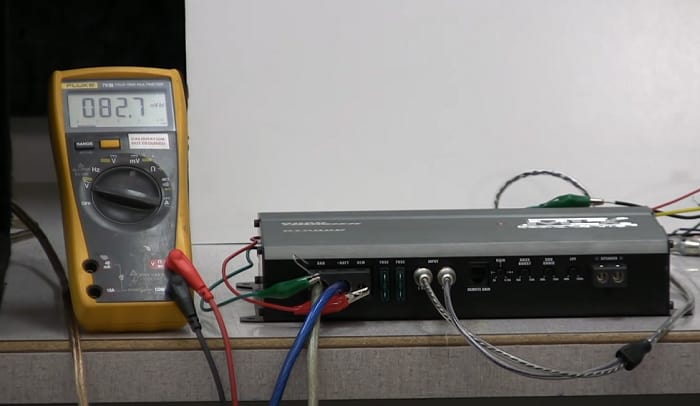
A multimeter amp setting is a complicated chore that may not apply to everyone. However, you can take information technology washed efficiently with the correct tools and the comprehensive guide below, including the knowledge of using a digital multimeter.
What to Prepare
- Multimeter (Preferably a digital one)
- Amplifiers manual for wattage output reference
- Calculator
- Test tone
- Modest flat screw to tune a sub amp
- Speaker for testing
Step 1. Measure the Speaker Resistance
To tune a monoblock amp or whatever other amp type, you can start by measuring the speaker's resistance.
Withal, you commencement need to disconnect the speaker'south power supply so that the readings will not be affected by other components, thereby becoming more accurate.
Now, using your multimeter, set it to the Ohm settings – you will detect an OLΩ symbol on the display screen. Then connect the reddish probe to the positive port (the Omega port with a VΩ symbol) of the speaker and the black one to the negative (the mutual) port.
For speakers' maximum resistance, reading tends to range between 2Ω and 8Ω, with ii, 4, eight, and 16 Ohms being the most common.
Stride 2. Prepare the Amplifiers Manual and Your Calculator
Using the amplifier's manual, notice the recommended wattage and note information technology downwardly. Using this manual recommended wattage and the speaker resistance y'all recorded earlier, you lot can now summate your target voltage.
You can use the Ohm's law in your calculation which has a formula of 5= √(P*R), which means Five for target voltage, P is for wattage, and R for resistance. In unproblematic words, y'all may become the Air conditioning voltage of the amps by getting the foursquare root of wattage multiplied past Resistance.
For example, you have a 75 watts amplifier for a 4 ohm load. In this example, 75 watts multiplied by 4 ohms is 300. Then you become its square root which is 17.32v target voltage.
However, if yous need to tune a four channel amp where yous demand two proceeds controls, you need to calculate each gain control separately using the same formula.
Stride three. Unplug All the Accessories of the Amplifier
When setting amp proceeds, it is proficient to disconnect all the amp accessories. These accessories include speakers, subwoofers, or whatsoever other components connected to the unit. Your amplifier should exist the only one continued to the ability source.
Nonetheless, you need to note where each terminal is currently connected to go far easy for yous to re-assemble. Accept a picture beforehand if you lot're not confident you can call up all the right wirings.
Furthermore, set up all the settings, volume, and proceeds to zero to prevent any issues and to accurately suit an amp gain.
Step 4. Set the Volume to 75% and Play the Test Tone
To fix the gain, you need to adjust the volume level to 75%. This volume level is needed to forestall the amps from making a distorted sound. Never play annihilation louder than this 75% threshold.
And so, play the test tone without any connected speaker to the amp. Too, note that the sound rating must exist upwards to 60Hz to tune subwoofer amp. As for mid-range and loftier-range amps, aim for 100Hz and grand Hz respectively.
On the other paw, if you accept great ears, you can prepare amp gain past ear. All yous need to do is to connect your speaker, play some music, and gradually increase the book until you lot hear a distortion.
Footstep 5. Connect the Multimeter
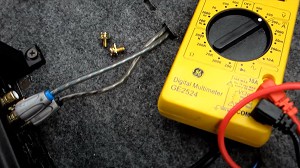
To start matching amp gain to caput unit y'all need to set up showtime the multimeter to Air-conditioning volt reading. So yous can connect the probes to each output terminal of the speaker. Connect the black lead to the negative speaker terminal and the red to the positive one.
This fashion, you can go the actual AC voltage of the amps. However, if you get 7v and higher up reading on your showtime effort, y'all might demand to reset all the settings, volume, and gain back to zero and try rereading it.
Step 6. Setting Gain with DMM (Digital MultiMeter)
To set the proceeds, find the adjusting gain knob and slowly turn it using a small-scale flat screw. While adjusting the knob, sentry the multimeter reading and cease when information technology reaches your calculated Air conditioning output voltage. Once you ready the AC voltage properly, your amp is ready to go.
Even so, to set gain on 4-channel amp y'all demand to echo the process of adjusting the gain for each amp channel.
Pace vii. Test Your Amp Setup
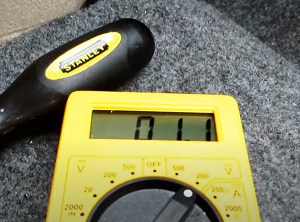
Now it is time to exam your sound system in real music. You tin can now connect all the amps accessories to their original setup and play your favorite music.
If you lot detect baloney audio, there might exist something wrong with your gain setting, and you might need to repeat all the steps above.
In addition, you may need to prepare LPF with multimeter to delocolize the filter. Similarly, adjusting the HPF can as well help you achieve a smoother sound quality.
However, if everything is alright, yous can now relish your best music someday.
- Note: There are other methods using other devices, such as an Oscilloscope and bass knob remote, to set proceeds on subwoofer amp.
FAQs
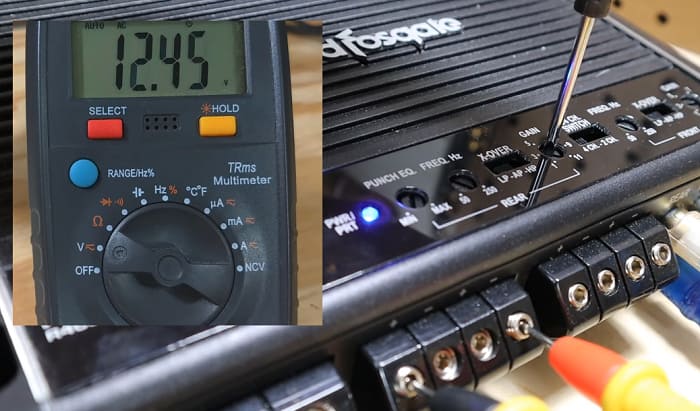
How to Tell if Amp Proceeds is also High
Usually, when the set amplifier gain is besides high, even if the book level is lower, it can hands attain the amplifier's maximum power. In this instance, the music becomes distorted earlier it passes the gain level.
To forestall further problems, you should properly tune an amp gain to avoid damage to your speakers. You might need to start at minimum settings and slowly power up the system while slowly adjusting the volume until it reaches the maximum level.
How Do You Test an Amp to See if it Works?
You lot can plug the amp unit into your wall outlet to see if it works perfectly. Still, if it does not piece of work, you tin look for visible signs of damage, such every bit broken or loose wire connections and h2o damage in the class of moisture.
If yous run across these signs, it is better to call a professional electrician to repair them to handle the electrical trouble and check other issues appropriately.
Why Does My Amp Go into Protection Mode When I Turn It On?
Sudden activation of the protection mode of an amp unit is primarily due to overheating. This feature of the amplifiers is significantly helpful in preventing more all-encompassing harm to the unit of measurement.
Usually, the best way to fix this issue is by providing the unit of measurement with proper ventilation or lessening the continued speakers.
Related:
- 3 Piece of cake Steps to Exam a Circuit Breaker with a Digital Multimeter
- Detailed Steps to Test a GFCI Billow with a Multimeter
Conclusion
Knowing how to melody an amp with a multimeter is highly advantageous and effective in producing the near splendid sound. Furthermore, this process can be quick if you have enough knowledge of digital multimeters.
However, if you are having trouble irresolute the proceeds setting to tune car amp, seeing an expert is a smart selection, equally incorrectly increasing the proceeds might damage the audio quality and unit. For instance, too-high amp gain may result in overheating the speaker.
We promise that this guide is helpful. Don't exist agape to reach out to us if y'all accept any questions.

I am Edwin Jones, in charge of designing content for Galvinpower. I aspire to use my experiences in marketing to create reliable and necessary information to assist our readers. It has been fun to work with Andrew and apply his incredible knowledge to our content.
Source: https://www.galvinpower.org/tune-an-amp-with-a-multimeter/
0 Response to "How To Tune A Monoblock Amp With A Multimeter"
Post a Comment